
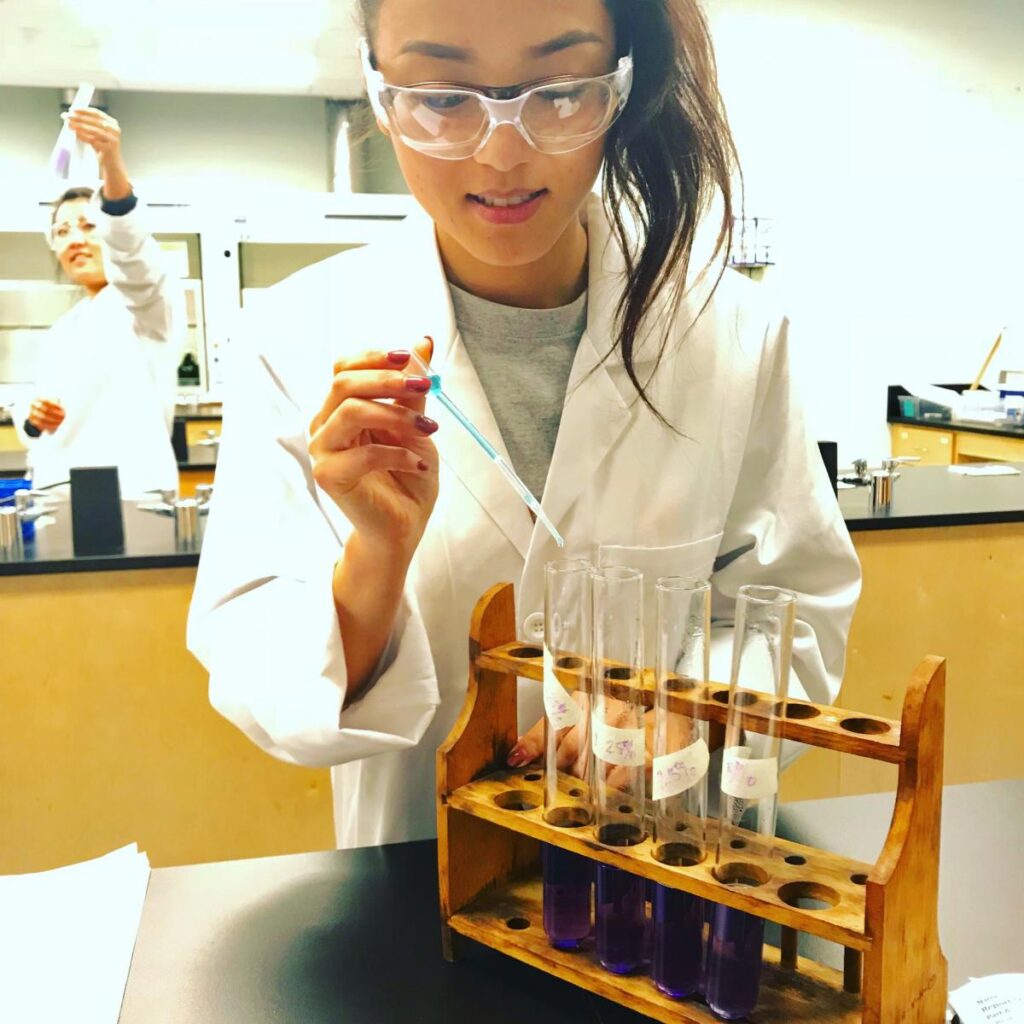
You finally did it. You went back to school!
You rearranged work schedules, figured out family responsibilities, and made room for a career you’re excited about. Nursing, medical technology, radiologic technology—you have a goal, and you’re putting in the work.
Then chemistry showed up.
Now you’re staring at equations after a long day, wondering how everyone else seems to understand something that feels like a foreign language. You need to pass this class to move forward, and suddenly one course feels like it’s holding your entire future hostage.
Struggling with nursing school chemistry does not mean you chose the wrong career or that it was a mistake to go to nursing school or into allied health. It means you need to identify what’s getting in your way—and change how you tackle it.
Here are five common mistakes that can make chemistry harder than it needs to be, along with practical ways to fix them.
5 big no-no’s of learning nursing school chemistry
1. Memorizing the steps without understanding what they mean
You find a worked example, memorize the steps, and feel ready.
Then the exam changes the wording, and you have no idea where to start.
Memorizing a procedure can help you repeat one problem. Understanding the reasoning helps you handle a different one.
How to fix it: Before reaching for an equation, answer three questions:
- What information do I have?
- What am I trying to find?
- How are those quantities connected?
For example, concentration describes how much of a substance is present in a certain amount of solution. If you add water while keeping the amount of dissolved substance the same, the concentration decreases.
Understanding that relationship gives you a way to check your calculation. If your answer says the concentration increased, something went wrong.
Try this today: After solving a problem, explain why your approach works as if you were teaching a classmate. Anywhere you get stuck explaining is a useful place to review.
2. Trying to learn new chemistry on top of rusty math
Sometimes the chemistry makes sense—until a fraction, exponent, or unit conversion enters the picture.
If you haven’t rearranged an equation in 15 years, that doesn’t make you bad at science. It makes you someone who hasn’t rearranged an equation in 15 years.
But avoiding that gap means it keeps showing up in every new chapter.
How to fix it: Identify the specific skill that causes trouble. You probably don’t need to relearn all of algebra. You may need a refresher on:
- Rearranging a simple equation.
- Working with scientific notation.
- Converting between units.
- Using parentheses and exponents on your calculator.
Suppose a practice problem asks you to convert 250 milliliters to liters:
250 mL × (1 L ÷ 1,000 mL) = 0.250 L
The milliliter units cancel, leaving liters. Writing the units shows you why the setup works.
Try this today: Look at three problems you missed. Was the difficulty chemistry, math, or interpreting the question? Fix the actual problem instead of reviewing the entire chapter again.
3. Watching someone solve problems without solving any yourself
You watch a video and think, “Okay, that makes sense.”
Then you close it, open your homework, and…nothing.
Following an explanation and producing a solution are different tasks. Watching someone parallel park doesn’t mean you’re ready to squeeze your own car into that space.
How to fix it: Turn each explanation into a practice session:
- Watch one worked example.
- Pause and explain the reasoning in your own words.
- Solve a similar problem without looking.
- Check your answer and locate the first step where you went off track.
If you need help, look at one step, then try again. The goal is to gradually do more of the thinking yourself.
Try this today: For every short lesson you watch, complete at least one problem independently. A finished video is useful; a problem you can solve is better evidence of progress.
4. Saving chemistry for one exhausting study marathon
When you’re balancing work, children, and school, studying often gets whatever time is left.
Unfortunately, “whatever time is left” may mean Sunday night, when you’re exhausted and the exam is Monday.
A marathon session also leaves little time to discover a question, ask for help, and practice the answer.
How to fix it: Build a small study routine that fits your actual life.
Start with 20 minutes:
- Five minutes: Recall yesterday’s ideas without opening your notes.
- Ten minutes: Work through one or two problems.
- Five minutes: Check your work and write down what needs clarification.
On your next study day, return to the part that gave you trouble.
Try this today: Put three short chemistry sessions on your calendar before your next exam. Give each session one specific job, such as practicing unit conversions or explaining ionic bonding.
You don’t need a perfect schedule. You need a repeatable next step.
5. Waiting until you’re completely lost to ask for help
Returning to school as an adult can come with an extra layer of pressure: “I should be able to figure this out.”
So you reread the same paragraph, avoid office hours, and hope the next chapter makes more sense.
The trouble is that later topics often depend on earlier ones. A small misunderstanding can become a much bigger obstacle.
How to fix it: Ask for help while the question is still manageable—and make it specific.
Instead of “I don’t understand chemistry,” try:
- “I can balance the equation, but I don’t know how to use the coefficients.”
- “I understand the formula, but I’m unsure which values belong in it.”
- “I get a different answer on my calculator. Can we check how I entered it?”
Bring your attempted work to your instructor, campus tutoring center, study partner, or chemistry tutor. It gives them a starting point.
Try this today: Write down one question you’ve been avoiding and take it to someone who can help. Asking early is a practical study decision, not an admission that you don’t belong.
Your next step doesn’t have to be a giant one
You don’t have to master the whole course tonight.
Pick one concept. Find an explanation you understand. Work through one problem. Then build from there.
At Virtually There Teaching, we break chemistry into focused, 10–15-minute video lessons designed to explain both what is happening and why. You can pause, rewind, and revisit an idea as you practice.
Start with a free sample lesson on the topic that’s giving you trouble at Virtually There Teaching.
You’ve already taken the big step of going back to school. Let’s work on the chemistry step in front of you.