
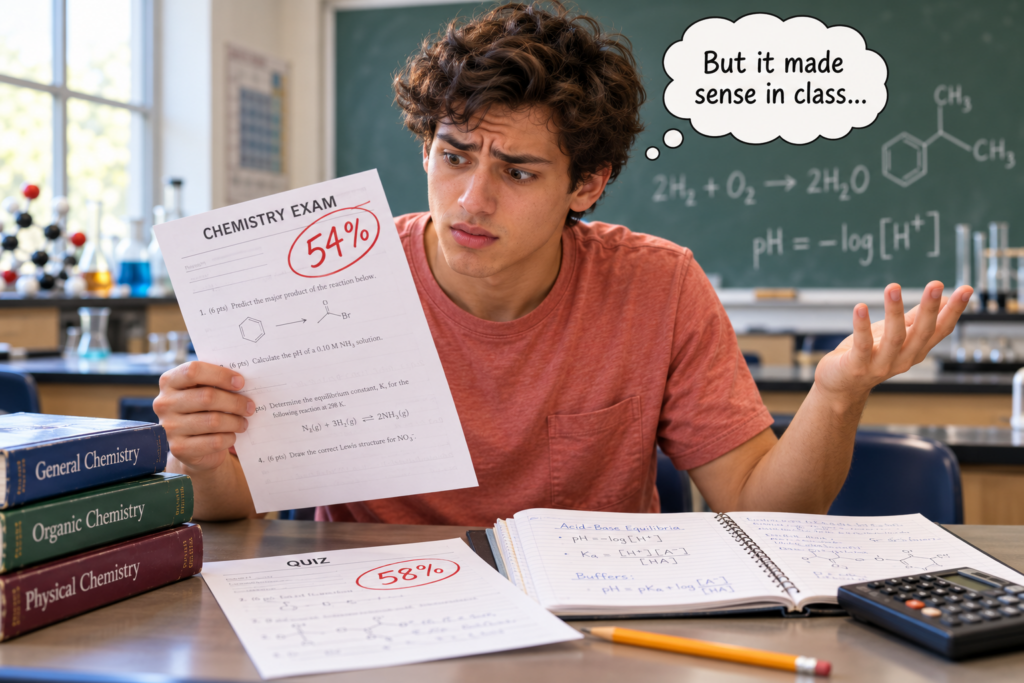
“My Child Understands Chemistry but Fails the Test”: Why It Happens and How to Help
By Jorge Camacho, Virtually There Teaching
If I had a dollar for every parent-teacher conference that started with this sentence, I would have retired years ago: “I don’t get it. They understand chemistry but fail tests, and I don’t know why.”
If that’s your kitchen table right now, I want you to hear two things first.
Your child is probably not lying to you, and they’re probably not “just bad at chemistry.” When a student says “I get it,” they usually mean it. The problem is that getting it while someone explains it and doing it alone on a test are two very different skills. Most students are only practicing the first one.
Every new school year starts with the same advice and warning from me: “This is not a memorization class, this is a demonstrate-mastery class!” What I mean is that most students come armed with the simple tools of rote memorization rather than the practical skills it takes to understand a concept.
Angie was a perfect example. She was a great student in class, took meticulous notes, and could spout back definitions. However, if I asked her an “explain why” question, the wheels quickly fell off the wagon. At the heart of the issue was that Angie wasn’t focusing on the why of a process. She just wanted to pull the right series of levers and hope the right answer came out. This led to several poor grades and lots of tears over what she was missing.
The solution, and the aha moment, came when I asked her to explain a concept to me as if she were teaching it to her “abuela,” her grandmother. Suddenly she couldn’t lean on all the jargon she had studiously memorized. She was forced to use simple, everyday words that a child could understand. That’s when Angie finally started to demonstrate mastery, because to know she really got a concept, she had to be able to explain it correctly and efficiently in layman’s terms.
In 25 years of teaching chemistry, I’ve seen the same handful of causes over and over. The good news is that every one of them is fixable, and you don’t need to know any chemistry to help.
The six real reasons why your child understands chemistry but fails the test:
1. Recognizing isn’t the same as understanding
This is the big one, and it explains most of the gap.
When your child rereads their notes, everything looks familiar. Familiar feels like understanding. But on a test, there are no notes. Your child has to pull the information out of their own head, with nothing in front of them to jog their memory.
Think about it this way. You’d recognize your best friend’s phone number if you saw it on a screen. Could you write it down from memory right now? That’s the difference between recognizing and recalling, and tests only measure the second one. A more thorough explanation of the distinction between recognition and understanding can be found here.
2. They’re studying by reading, but chemistry is tested by doing
Ask your child how they studied. Nine times out of ten the answer is some version of “I went over my notes” or “I looked at the study guide.”
Chemistry isn’t a reading subject. It’s closer to math or a sport. You don’t get better at free throws by watching someone else shoot them. A student who has watched the teacher solve ten problems, but hasn’t solved any alone, is going into the test having never actually practiced the thing they’re being tested on.
3. The chemistry is fine. The math isn’t.
This one hides really well. A student can genuinely understand the idea of a chemistry problem and still get it wrong because of the algebra, fractions, scientific notation, or unit conversions underneath it.
When I look at a test where a student “understood it but got it wrong,” I very often find the setup was right and the arithmetic or rearranging went sideways. That’s not a chemistry problem, and more chemistry notes won’t fix it. A classic example is stoichiometry, where students understand the idea of predicting how much product forms but trip over the conversions along the way.
4. Class examples are straightforward. Test questions twist them.
In class, your child sees a problem right after learning the method, so they already know which tool to use. On a test, the questions are mixed together, worded differently, and sometimes combine two ideas at once. The hardest part of a test question often isn’t solving it. It’s figuring out which kind of problem it is.
If your child has only practiced one topic at a time, in order, they’ve never practiced that decision.
5. Small mistakes add up
Forgotten units. A dropped negative sign. Copying a number wrong from one line to the next. Not answering the question that was actually asked. Each one costs a point or two. Across a whole test, it can easily be the difference between a B and a D, even when the understanding is there.
6. Time pressure and nerves
Some students know the material and still freeze. Working slowly and carefully at home with no clock is very different from working against one in a quiet room where everyone else seems to be writing faster. If your child says “I blanked” or “I ran out of time” a lot, pay attention to that. It’s real, and it’s also something practice helps with.
What you can do at home (no chemistry required)
You don’t need to know what a mole is to help. You just need to change how your child studies. Here’s what I’d ask you to try.
So my child understands chemistry but fails the test: Try the blank-page test
Tonight, ask your child to close the notes, take out a blank sheet of paper, and write a simple explanation of everything they remember about the current topic. Then open the notes and compare.
Whatever is missing from that page is what will be missing on the test. This takes ten minutes, and it’s the single most eye-opening thing I’ve ever had students do.
So my child understands chemistry but fails the test: Swap rereading for practice problems
Every study session should end with your child solving problems with the notes closed. Not looking at worked examples. Actually solving them, start to finish, then checking the answers.
If they get stuck, that’s not failure. That’s the studying working. Being stuck at the kitchen table is much better than being stuck during the test.
So my child understands chemistry but fails the test: Have them teach it to you
Ask your child to explain a problem to you like you’re the student. You don’t need to know if they’re right. Listen for hesitation, “um, you just kind of…”, or skipped steps. Those are the shaky spots. It’s fine (honestly, it’s better) if you know nothing about chemistry. It forces them to explain clearly.
Read the returned test together
When a test comes back, don’t just look at the grade. Sit down with it and, for every lost point, ask one question: “What kind of mistake was this?”
- Didn’t know it
- Knew it but made a math slip
- Misread the question
- Ran out of time
After one or two tests, a pattern almost always shows up, and the pattern tells you exactly what to work on. A student who loses most points to math slips needs something completely different from a student who didn’t know the material.
Spread it out
Three 20-minute sessions across the week beat one two-hour cram the night before, every time. Chemistry builds on itself, so the student who keeps reviewing old topics as new ones arrive is the one who stops falling behind.
Practice with a clock
Once or twice before a test, have your child do a set of problems with a timer running. It doesn’t need to be stressful. The goal is to make the test conditions feel familiar, so the real test isn’t the first time they’ve felt that pressure.
Talk to the teacher
A short, friendly email to the teacher asking “Where do you see my child losing points?” can save weeks of guessing. Most teachers I know love getting that email. It tells them a parent is on their side.
When it’s time to get extra help
These habits fix the gap for a lot of students. But if you’ve tried them for a few weeks and the scores aren’t moving, or your child is already far behind and the next test is close, it’s worth bringing in support. If things have gotten urgent, start with our Failing Chemistry? A 2-Week Recovery Plan.
That’s exactly why I built Virtually There Teaching. Our courses are designed around doing, not just watching: short lessons followed by practice. Between lessons, students can work through problems with Tilly, our AI study coach, who helps them get unstuck without just handing over the answer. And when a student needs a real person, live tutoring is there. Just reach out and contact us to set up times and learn about rates.
Get online help or Try a few free lessons.
Quick answers for parents
Why does my child understand chemistry in class but fail tests? Usually because recognizing an idea when someone explains it is different from recalling and applying it alone. Most students study by rereading, which builds recognition, while tests require recall and problem solving.
How should my child study for a chemistry test? By solving practice problems with the notes closed, explaining answers out loud, and reviewing a little each day instead of cramming the night before.
Is my child bad at chemistry, or bad at math? Sometimes it’s the math. Go through a returned test together. If the setup is right but the numbers go wrong, the fix is math practice, not more chemistry.
How can I help with chemistry if I don’t know chemistry? You don’t need to. Ask your child to teach you a problem, quiz them with the blank-page test, and help them sort the mistakes on returned tests. Those habits matter more than any content knowledge.
When should I get a tutor? If better study habits haven’t moved the scores after a few weeks, or if your child is falling behind faster than they can catch up.
The takeaway
When your child says “I understand it,” believe them, and then hand them a blank sheet of paper. Understanding is the starting line, not the finish line. The students who do well on tests aren’t always the ones who understood it best in class. They’re the ones who practiced doing it alone before the test asked them to.
You can help with that, starting tonight.
Jorge Camacho has taught chemistry for 25 years and is the founder of Virtually There Teaching.