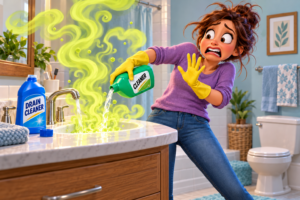
By Jorge Camacho, Virtually There Teaching
Here’s a question I’ve been asked more times than I can count, and almost never by a student. It comes from parents at back-to-school night, from neighbors, from friends who just finished scrubbing a bathroom: “Is it true you can’t mix bleach with other stuff?”
Yes. It’s true. Mixing cleaning products will not make a “stronger or better disinfecting” cleaner. And it’s one of the few places where a little chemistry knowledge can genuinely keep you out of the emergency room.
By far the most memorable is the “ferret lady” story, where the mom of a former student, who had four ferrets indoors, decided one day to clean out all of the litter boxes with bleach to “clean ’em well.” However, what she failed to realize was that all that clumped litter was soaked with urine, and old urine breaks down into ammonia. So when she started spraying them all down simultaneously to disinfect them, she almost passed out in the small bathroom where she kept them all!
The good news is you don’t need a chemistry degree to stay safe. You need to know about six combinations, and one big idea that explains all of them. Let’s go.
What it makes: chloramine gases.
This is the famous one, and for good reason. Ammonia hides in more places than people realize: many glass and window cleaners, some multi-surface sprays, and, here’s the one nobody thinks about, urine. That’s why pouring bleach into a litter box, a diaper pail, or a toilet that hasn’t been flushed can cause trouble.
Chloramines irritate your eyes, nose, and throat almost immediately. In a small, closed bathroom, they can cause coughing, shortness of breath, and fluid in the lungs.
What it makes: chlorine gas.
People do this one with good intentions. Vinegar cleans, bleach disinfects, so together they must be a super-cleaner, right? Unfortunately, no. Adding an acid to bleach releases chlorine gas, the same gas used as a weapon in World War I.
Vinegar isn’t the only acid to watch for. Many toilet bowl cleaners, rust removers, and lime-and-scale removers are acidic too. If the label says “removes hard water stains” or “dissolves rust,” assume it’s an acid and keep it far away from bleach.
What it makes: chloroform and other chlorinated compounds.
Yes, chloroform, the stuff from old movies. Real life is less dramatic and more unpleasant: dizziness, nausea, and irritation, plus other harmful byproducts. This combo shows up when someone wipes a surface with alcohol, then follows with a bleach spray without rinsing in between.
What it makes: peracetic acid.
This one surprises people because both ingredients feel gentle. Mixed together in one bottle, though, they form an acid that’s corrosive to skin, eyes, and lungs. Using one, rinsing, then using the other is fine. Storing them premixed in a spray bottle is not.
What it makes: intense heat, spattering, and sometimes toxic fumes.
Some drain cleaners are strong bases (often labeled as containing lye or sodium hydroxide). Others are strong acids. When the first one doesn’t work and you pour the second one on top, the two react violently in your pipe, and the mixture can boil and splash back up at you. If one drain cleaner fails, stop and call a plumber. Tell them exactly what’s already in the drain.
What it makes: heat, toxic gas, and in some cases fire.
If you have a pool, you probably have more than one chlorine product in the shed. Different types of chlorine (granules, tablets, shock) are not interchangeable and can react dangerously with each other, or with acids used to balance the water. Keep them in their original containers, stored separately and dry, and add each one to the pool water on its own.
Baking soda + vinegar won’t hurt you. It’s the classic volcano reaction. But here’s the funny part: the fizzing is the two cancelling each other out. By the time the bubbles stop, you’ve basically made salty water. Great science fair project. Not much of a cleaner.
Notice that bleach shows up in half that list. That’s not a coincidence.
Bleach works because it’s reactive. That’s its whole job. The active ingredient, sodium hypochlorite, is basically chlorine looking for something to grab onto. When it grabs onto germs, it tears them apart. That’s great. But it isn’t picky. Give it ammonia, an acid, or alcohol, and it’ll react with those too, and the products are gases.
And gases are the real problem. Three reasons:
Here’s how I’d put it to a class: the same property that makes bleach good at killing germs is what makes it bad at sharing a bucket. Strong cleaners are strong because they react. Mix two strong reactors and you’re running a chemistry experiment with your lungs as the test tube.
The drain cleaner and pool examples follow the same logic, just with heat instead of (or along with) gas. Acids and bases cancel each other out, and when they’re concentrated, that cancelling releases a lot of energy very fast.
Accidents happen, even to chemistry teachers. If you mix something and notice a sharp smell, stinging eyes, or start coughing:
Can you mix bleach and vinegar? No. Vinegar is an acid, and acids release chlorine gas from bleach.
Can you mix bleach and dish soap? Most plain dish soaps don’t react with bleach, but some contain ammonia or other additives. The safe rule is simple: don’t mix bleach with anything except water.
Is it safe to mix two different brands of the same product? Not always. “Bathroom cleaner” from one brand might be acidic and from another might contain bleach. Check labels, or just don’t mix.
What should I do if I smell a strange odor while cleaning? Stop, get to fresh air, and call Poison Control at 1-800-222-1222 if you feel any symptoms.
Is baking soda and vinegar dangerous? No. It fizzes, but the two mostly cancel each other out. Safe, just not very effective as a cleaner.
You don’t need to memorize a chemistry textbook to keep your home safe. Remember this: bleach plays alone, and one product at a time is always the right call.
If this made you a little more curious about how the stuff under your sink actually works, that’s exactly the feeling I’ve spent 25 years trying to spark in my students. If there’s a student in your house who’s struggling with chemistry, take a look at how Virtually There Teaching works, or try a few free lessons.
Jorge Camacho has taught chemistry for 25 years and is the founder of Virtually There Teaching.
This article is for general educational purposes. In a poisoning emergency, call Poison Control at 1-800-222-1222 or 911.